
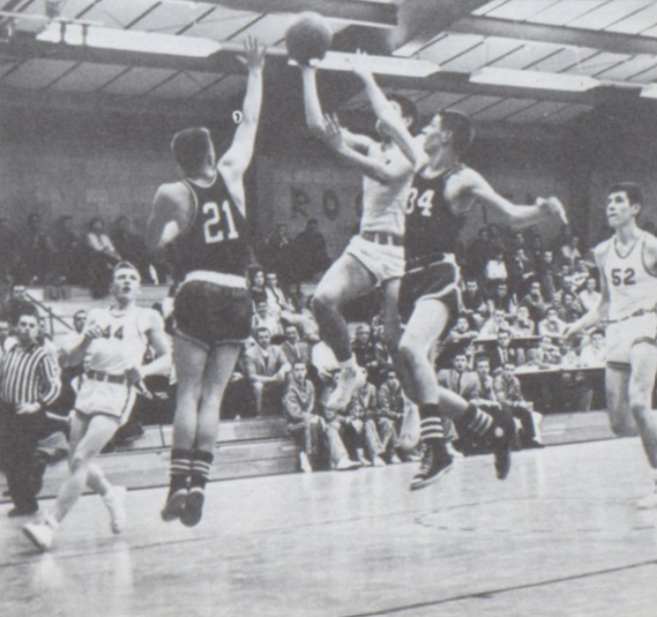
Arrowhead, 1958 SEC Basketball Champions
While the new Arrowhead district was off to a flying start, the continued existence of two other SEC members came under threat. Rochester, officially known as the Racine County School of Agriculture and Domestic Science, was the last of Wisconsin’s agricultural high schools, drawing its enrollment from western Racine County. Unlike other high schools, however, it was administered at the county level rather than by a local school district. That arrangement drew the ire of neighboring districts such as Burlington and Waterford, which argued that county funds were providing free tuition to students who otherwise would have paid to attend their schools. At a November 1956 meeting that stretched into the early hours of Thanksgiving Day, the Racine County Board of Supervisors voted to close Rochester after the 1958-59 school year.
Approximately a year later, the Board of Regents at Whitewater State College, today’s UW-Whitewater, voted to close College High, one of the last college-run laboratory schools in Wisconsin. After the decision was finalized in March 1958, the school stopped accepting freshmen and closed at the end of the same school year as Rochester. College High’s students were absorbed by Whitewater High School as part of a newly reorganized district, while the symbiotic relationship between the city’s public high school and its institution of higher learning continues to this day.
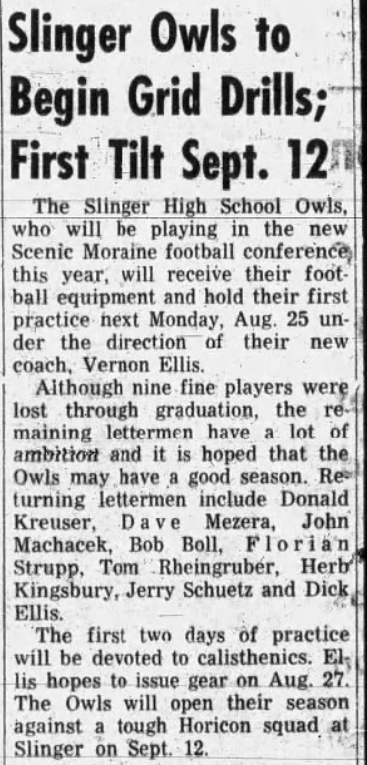
West Bend News, August 21, 1958
More changes were taking place in Walworth County, one of the few southeastern Wisconsin counties adversely affected by rural school district consolidation. Most of the smaller schools belonged to the Southern Regional Conference, and four of them—Darien, Genoa City, Sharon, and Walworth—were involved, along with Delavan and Lake Geneva of the Southern Lakes Conference. The first domino fell when Delavan and Darien merged into a single school district, with voters in the two villages approving the referendum by a 5:1 margin in December 1954. An even larger majority of voters in Walworth and Sharon followed suit in February 1955, creating what would eventually become the Big Foot School District, named for Chief Big Foot of the Prairie Band of the Potawatomi.
Efforts to create a new union free high school district in Lake Geneva met with more resistance. A merger with Genoa City and Williams Bay was first discussed in November 1954, but Williams Bay withdrew from the talks and voted to retain its own district. Lake Geneva and Genoa City proceeded on their own, holding a referendum in May 1955 that passed by a much narrower margin than the other Walworth County mergers, with fewer than 100 votes separating the two sides. Lake Geneva voters overwhelmingly supported consolidation, while residents of Genoa City and the surrounding communities preferred to retain their existing district. Their opposition ultimately proved unsuccessful, and the new Lake Geneva-Genoa City School District made plans to open Badger High School no later than the 1958-59 school year.
Delavan-Darien High School opened in the fall of 1957, followed a year later by Badger and Big Foot. Both Badger and Delavan-Darien inherited their predecessors’ places in the Southern Lakes, helping solidify the conference’s long-term presence in southeastern Wisconsin. The SEC reshaped its membership as well, adding Big Foot, Clinton, Palmyra, and Salem Central in January 1958. Salem Central’s arrival was particularly beneficial: for the previous three seasons, it had belonged to the Braveland Conference, whose members were concentrated farther north, making Salem Central a pronounced geographic outlier.
The arrival of those four schools offset the departure of four others: Rochester (whose closure was already scheduled) Slinger, Pewaukee, and Arrowhead. Slinger was the first to leave, becoming a founding member of the Scenic Moraine Conference. Its first competition was a track meet held in April 1958 before beginning full membership with the 1958-59 school year. The Scenic Moraine’s original roster consisted of Campbellsport, Germantown, Grafton, Kewaskum, North Fond du Lac, and Slinger, placing Slinger in a much more central position geographically than it had occupied in the SEC. Pewaukee followed in January 1959, joining the Scenic Moraine alongside Kettle Moraine Conference member Random Lake. Its official transition came after competing in the SEC through the 1958-59 fall sports season. At just over 300 students, Pewaukee entered as the Scenic Moraine’s largest school, edging Kewaskum and nearly doubling the enrollment of its smallest member, Grafton, at 166.
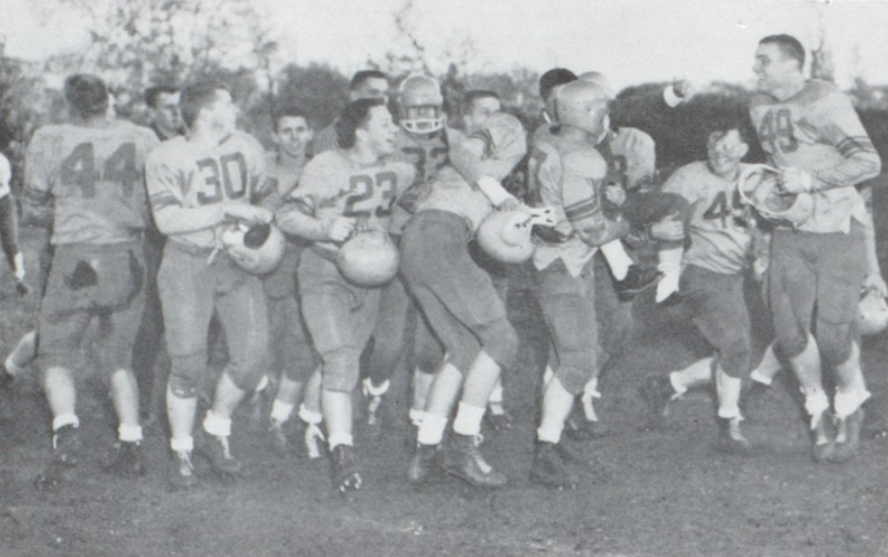
Delavan-Darien, 1958 Southern Lakes Football Champions
Of all the schools realigning, Arrowhead made the biggest splash by entering the competitive Little Ten Conference, a league populated by considerably larger schools. Arrowhead and Watertown were admitted in May 1958, with competition beginning in the 1959-60 school year. By then, enrollment projections had Arrowhead reaching 600 students by 1960, rapidly surpassing the district’s original estimates. Even with that growth, however, Arrowhead remained the Little Ten’s smallest school. Enrollment ranged from about 650 at Hartford Union to more than 1,000 at West Bend.
While the Southern Lakes and SEC strengthened their ranks during this reshuffling, the Southern Regional Conference was completely wiped off the map. Four of its schools had disappeared through consolidation, College High had closed, four more were preparing to join the SEC, and its Illinois-based members—North Boone (formerly Capron) and Richmond-Burton—had previously departed for the SHARK Conference. That left Williams Bay as the SRC’s only remaining member. Having already rejected a merger with Lake Geneva and Genoa City, the school had few options for the 1958-59 school year. In June 1958, Williams Bay joined the Southern Wisconsin Association of Private Schools (SWAPS) Conference as its only traditional, district-based public high school. The other members were Beloit Catholic, Northwestern Military and Naval Academy in the town of Linn, St. John’s Military Academy in Delafield, St. Mary’s (today’s Catholic Central) in Burlington, and the Wisconsin School for the Deaf in Delavan.
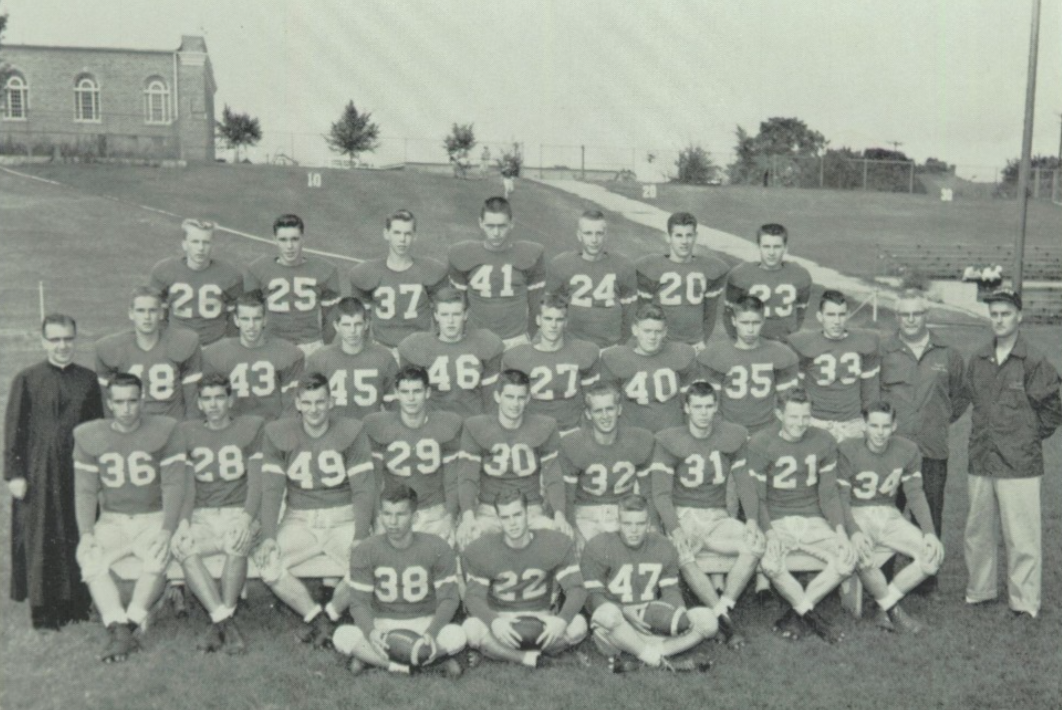
1961 St. Mary’s High School Football Team
The demise of the Southern Regional Conference ushered in another period of volatility in the region’s athletic alignments. Williams Bay spent only one school year in SWAPS before being accepted into the SEC in March 1959 as a direct replacement for the three schools preparing to leave. Although the SEC had now stabilized at eight members, three of its largest schools—Big Foot, Salem Central, and Union Grove—were already seeking admission to the larger Southern Lakes Conference. In March 1959, Big Foot’s application was the only one accepted, and the SLC planned to welcome the Walworth County school as its ninth member for the 1961-62 school year. For Salem Central and Union Grove, however, it would be the first of many unsuccessful bids; neither would find a resolution for nearly a decade.
With Big Foot’s impending departure, the SEC moved in May 1960 to add Burlington-based St. Mary’s High School as a replacement for fall 1961. At the time, St. Mary’s was one of the few private high schools in Wisconsin competing primarily against public, district-based schools. It belonged to the Wisconsin Catholic Interscholastic Athletic Association and competed for state championships under that organization’s auspices. While the WIAA did not prohibit private schools from joining public high school conferences, St. Mary’s entry into the SEC came with two conditions: a one-year probationary period before full membership and exclusion from SEC competitions involving more than two members. In practice, the school could participate in team sports such as basketball, football, and baseball, as well as dual meets in individual sports, but not in conference tournaments.
St. Mary’s arrival provided the SEC with a temporary solution, but it did little to answer the larger question of where the conference—and its remaining schools—fit within a rapidly changing athletic landscape. As the 1960s began, schools increasingly looked beyond their existing affiliations for leagues offering a better geographic and competitive fit, resulting in further alignment that shaped competition in far southeastern Wisconsin.
