
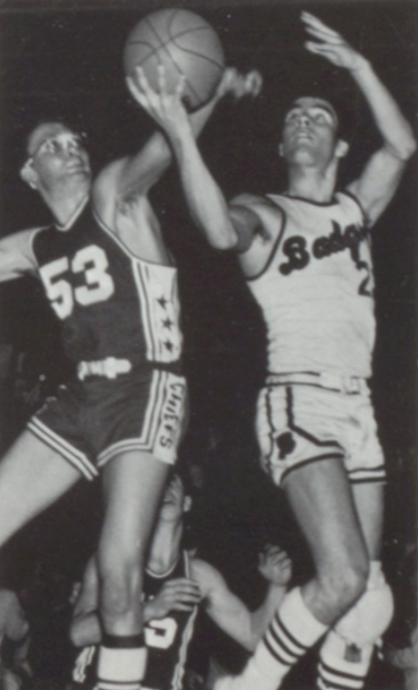
Badger, 1968 Southern Lakes Basketball Champions
By the end of 1960, reports indicated that Waterford was joining Salem Central and Union Grove in seeking membership in the Southern Lakes Conference. This shift would not be possible until fall 1963, with the conference’s schedules already set through the 1962-63 school year. That timeline was accelerated a little over a year later. One day before Valentine’s Day in 1962, the SEC received a Dear John letter from its four smallest public schools—Clinton, Norris Foundation, Palmyra, and Williams Bay—announcing the formation of the Indian Trails Conference. The new league would begin competition with the spring 1963 baseball season and enter full competition the following school year. The four public schools were joined by former SWAPS members Northwestern Military and Naval Academy and the Wisconsin School for the Deaf.
With Southern Lakes membership effectively off the table until 1963, Salem Central, Union Grove, and Waterford wasted no time preparing their next application, submitting it a few days after New Year’s Day. Neither enrollment nor geography posed an obstacle. At 673 students, Salem Central would have been the conference’s second-largest school, just behind Badger at more than 700. Union Grove (432) and Waterford (453) were also comparable in size to the Southern Lakes’ other members. The bid was rejected instead because of concerns among the nine existing schools about the travel and scheduling demands of a twelve-member league.
As a stopgap, the three schools formed the Southeastern Badger Conference with St. Mary’s, the SEC’s final remaining member, in late January 1963. What was intended as a temporary arrangement soon expanded. In June 1964, Arrowhead proposed moving from the Little Ten’s southern division to its northern division. Enrollment was the primary motivation: six years after joining, Arrowhead remained the smallest school in the southern division. A swap with Waupun, the northern division’s largest school, would improve competitive balance, although it would also increase travel to places such as Berlin and Ripon.
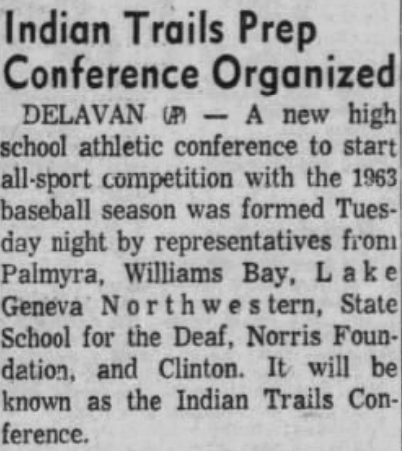
Wisconsin State Journal
February 15, 1962
Little Ten leadership rejected the proposal. A few months later, Arrowhead applied to join its former SEC rivals in the Southeastern Badger Conference, receiving final approval in October 1964 for competition beginning in 1965-66. It was joined by newly created Kettle Moraine High School in nearby Wales, which was scheduled to open in fall 1965 and was seeking a conference affiliation. At roughly 600 students, Arrowhead would be the league’s second-largest school, trailing only Salem Central at nearly 700. Kettle Moraine, with about 350 students, would be its smallest public school, although projected growth was expected to bring it more in line with Union Grove and Waterford within a few years.
The creation and expansion of the Southeastern Badger Conference temporarily halted the three schools’ pursuit of Southern Lakes membership, with the arrangement holding until spring 1967. After nearly a decade of persistence, Salem Central finally succeeded, with its application to become the conference’s tenth member approved in May 1967. Competition would begin with the 1969-70 school year, prompting the Southern Lakes to adopt a nine-game, conference-only football schedule. An even number of schools also solved basketball scheduling problems, allowing each to play an eighteen-game conference slate with home-and-home matchups against every opponent.
The Southeastern Badger Conference, already weakened to five schools, was now on the verge of disbanding, with early reports that all four public high schools were looking elsewhere. In November 1968, Union Grove and Waterford submitted another application to the Southern Lakes, this time joined by Arrowhead and Kettle Moraine, as well as Milton of the Madison Suburban Conference and Turner of the SHARK Conference. Shortly afterward, Arrowhead announced that it would instead join the Scenic Moraine Conference. Kettle Moraine also applied but was rejected, while Arrowhead inherited departing member Random Lake’s athletic schedule for the 1969-70 school year. The Southern Lakes, meanwhile, moved to delay further expansion.
In January 1969, just over a year after approving Salem Central, the Southern Lakes formally voted to remain at ten members for the time being. By then, Arrowhead had withdrawn its application after securing a place in the Scenic Moraine, while Milton and Turner were preparing to join the new Central Suburban Conference for the 1969-70 school year. Most Southern Lakes members favored bringing in Union Grove and Waterford, whose enrollment profiles and locations made them natural fits. Expanding to twelve schools, however, would require two divisions, and many members feared sacrificing rivalries that dated back to the turn of the century.
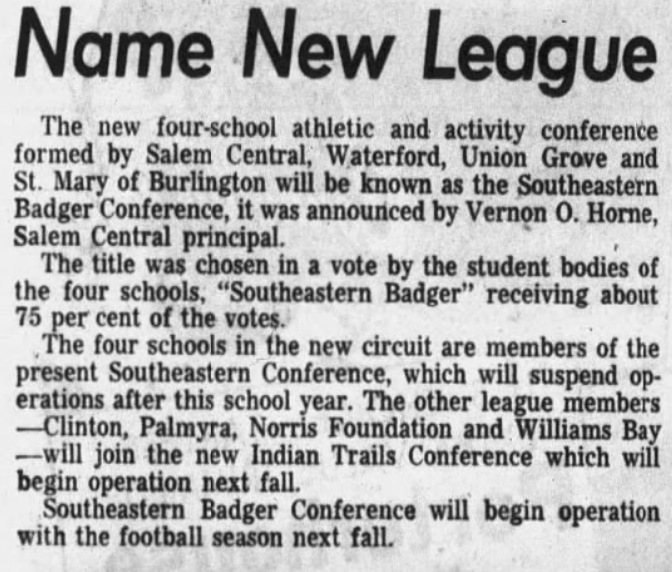
Kenosha News, January 31, 1963
Two months later, Southern Lakes leaders met again and reached an agreement on the admission of Union Grove and Waterford. Geography largely determined the new alignment. Both newcomers joined the eastern division alongside Burlington, Mukwonago, Salem Central, and Wilmot. The six Walworth County schools—Badger, Big Foot, Delavan-Darien, East Troy, Elkhorn, and Whitewater—formed the western division.
In May 1969, Kettle Moraine’s application to the Scenic Moraine Conference was approved. Mayville was also being considered as a possible eighth member, as the Northern Little Ten was scheduled to dissolve in spring 1970. Mayville officially joined in June, with the two newcomers replacing Campbellsport and North Fond du Lac. By the end of the 1960s, the Scenic Moraine included some of the state’s fastest-growing high schools, with enrollment ranging from about 450 students at North Fondy to just under 900 at Arrowhead. Campbellsport and North Fond du Lac had been among the conference’s smallest schools and joined similarly sized programs farther north that would eventually form the Flyway Conference. Kettle Moraine, meanwhile, had grown to nearly 700 students in just a few years and entered the Scenic Moraine as one of its larger schools.
The Southeastern Badger’s only remaining member was also its sole private school, and its future remained uncertain. In March 1970, the Milwaukee Archdiocese voted to end subsidies for Catholic high schools in Racine County, directly affecting St. Mary’s, which had previously voted to remain open until at least spring 1974. Before the year ended, St. Mary’s was accepted into the Midwest Prep Conference, joining an entirely private-school league in which most members belonged to the Wisconsin Independent Schools Athletic Association, successor to the WCIAA after its first non-Catholic members joined in 1968.
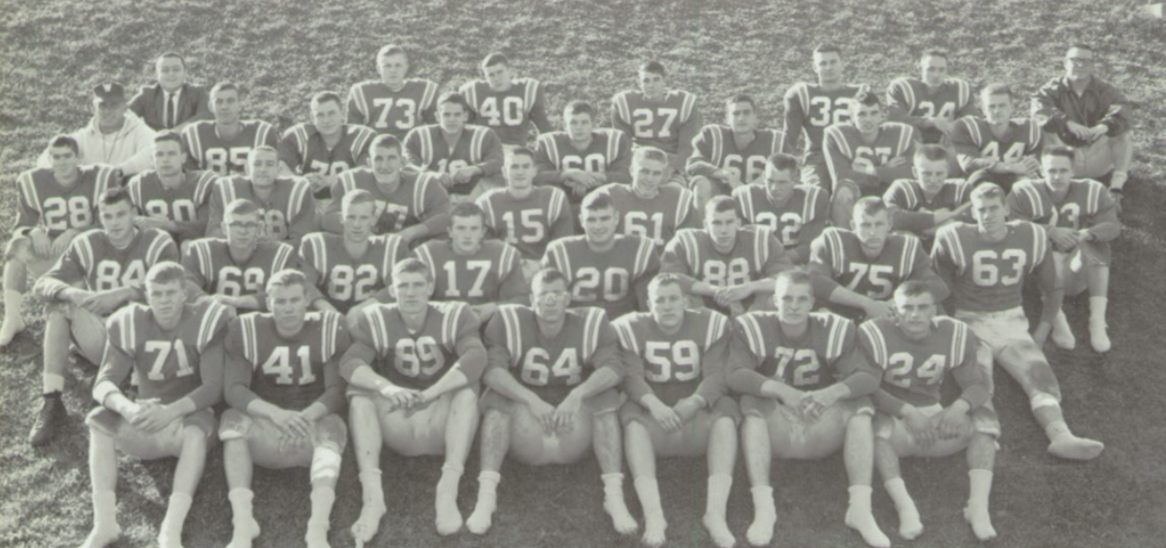
Waterford, Three-Time Southeastern Badger Football Champions (1965, 1967, 1970)
The Southern Lakes lost Mukwonago and Big Foot to realignment in the early 1980s, replacing them with Jefferson and Milton while maintaining a twelve-member, two-division structure. Another temporary split came in 1997, when five schools from the Eastern Division—Badger, Union Grove, Waterford, Westosha (formerly Salem) Central, and Wilmot Union—joined WISAA members St. Catherine’s of Racine and St. Joseph’s of Kenosha to form the new Lakeshore Conference. The WIAA and WISAA were set to merge by fall 2000, and WISAA members were being integrated into the WIAA's affiliated organizations. Burlington moved to the much larger Southeast Conference, while the remaining Eastern Division schools added Fort Atkinson from the Badger Conference, creating a smaller seven-member league.
That arrangement lasted just over a decade. All of the Eastern Division schools except Delavan-Darien and Elkhorn eventually departed, most joining the smaller Rock Valley Conference, while Fort Atkinson returned to the Badger Conference. The five public school members of the Lakeshore reunited with the Southern Lakes in 2008, and Burlington followed a year later. The final change happened in 2023, with Delavan-Darien moving to the Rock Valley and their replacement with Beloit Memorial, who found themselves the odd school out of the Big Eight Conference after Sun Prairie divided into East and West. Today, the Southern Lakes remains one of the region’s most competitive conferences, benefiting from the continued growth of the counties on the fringes of the Milwaukee and Chicago metropolitan areas.
