
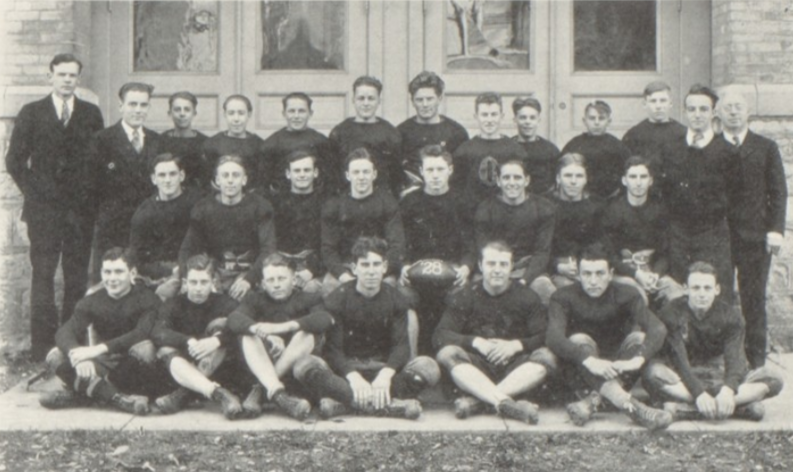
Elkhorn, 1928 Southern Five Football Champions
A century ago, the three counties in Wisconsin’s southeastern corner—Kenosha, Racine, and Walworth—were experiencing newfound prosperity and growth that brought them increasingly into the orbit of the region’s larger cities. Racine and Kenosha were bustling with industry, benefiting from their location between Chicago and Milwaukee along Lake Michigan. Farther west, smaller communities were making their mark as well. Lake Geneva was cementing its status as a getaway destination, Burlington was developing into an industrial center, and Whitewater State Teachers College was expanding, drawing new families to the area.
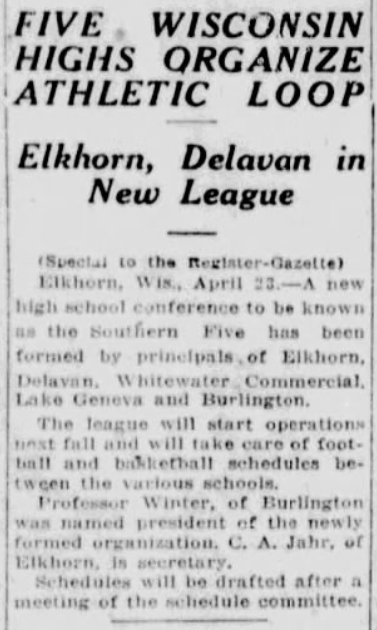
Rockford Register-Gazette, April 23, 1928
It was during this period that two conferences formed within months of each other across the three counties. The largest schools in Racine and Kenosha Counties already belonged to the Southern Wisconsin High School Athletic Association—the future Big Eight—along with schools in Madison, Janesville, and Beloit. Smaller schools banded together to create the Southern Five and Southeastern Conferences. The Southern Five formed first, in April 1928, with five schools in the larger communities west of Racine and Kenosha: Burlington, Delavan, Elkhorn, Lake Geneva, and College High in Whitewater, a laboratory school operated by the teachers’ college. Six months later, the public high schools of six smaller towns—Clinton, Genoa City, Palmyra, Waterford, Williams Bay, and Wilmot—formed the Southeastern Conference.
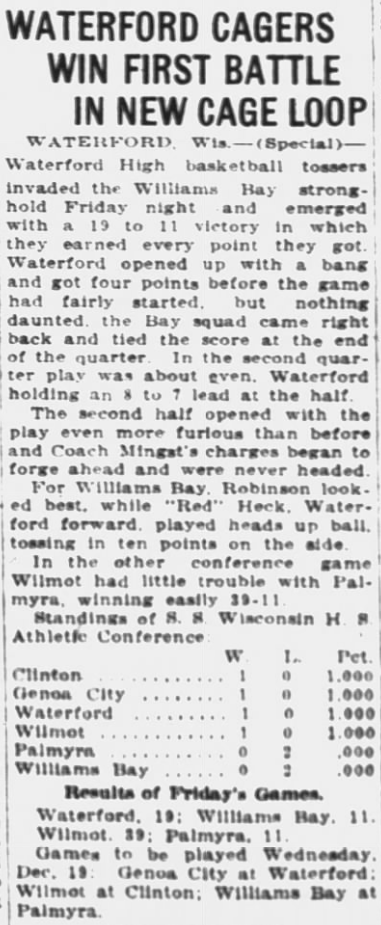
Racine Journal News, December 18, 1928
While the Southern Five began with a relatively stable roster, the SEC doubled in size over its first few seasons, adding Darien, Mukwonago, Norris Farm (also in Mukwonago), Rochester, Union Grove, and Walworth by the 1934-35 school year. To ease scheduling and limit travel, the SEC divided into eastern and western sections. The eastern section included Mukwonago, Norris Farm, Rochester, Union Grove, Waterford, and Wilmot; the western section consisted of Clinton, Darien, Genoa City, Palmyra, Walworth, and Williams Bay. A year later, Walworth left the SEC for the larger Southern Five, with football serving as the primary catalyst. Walworth was one of the few SEC schools to sponsor eleven-man football, and because the conference did not offer football at all, the move seemed a natural fit. Palmyra followed the next year, leaving the SEC with ten schools. Wilmot shifted to the western section to maintain an even split.
The start of the 1937-38 school year brought both major and minor changes to the Southern Five and SEC. The Southern Five, now a six-school circuit also known as the Southern State Conference, lost Walworth, while College High swapped places with Whitewater’s municipal high school. College High joined the neighboring Rock River Valley League, alongside schools from Jefferson and Rock Counties. The SEC underwent an even more sweeping transformation, effectively creating a third conference in the region. After Palmyra and Walworth had departed, four more members—Clinton, Darien, Genoa City, and Williams Bay—joined Capron High School, just across the Illinois state line in Boone County, to form the Southern Regional Conference.
As with Walworth’s move to the Southern Five, the decision to split the SEC was driven by football. Clinton and Darien already sponsored six-man football, a version of the sport designed for smaller schools that lacked the enrollment to field a full eleven-man roster. Williams Bay switched from eleven-man to six-man that same year, rounding out the SRC’s initial football membership. The SEC also began sponsoring eleven-man football in 1937-38, with its six remaining schools joined by East Troy. Before the SEC added football, most of its football-playing members—including new addition East Troy—belonged to the Lower Fox Conference. That league lasted only four seasons and met an unexplained end; as late as December 1936, its football coaches had already agreed upon a schedule for the 1937 season.
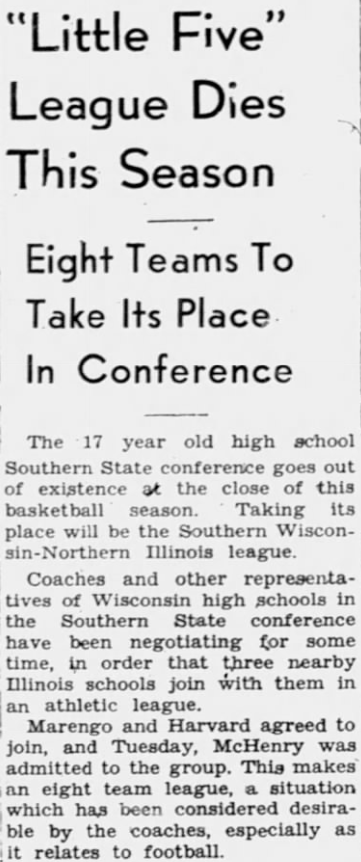
Lake Geneva Regional News, December 6, 1945
The SEC settled at seven schools, while the Southern Regional Conference added Palmyra and Sharon by the end of the decade. All three organizations remained largely unchanged until a few months after World War II ended. In December 1945, the five Southern Five members joined three schools from McHenry County, Illinois—Harvard, Marengo, and McHenry—to form the Southern Wisconsin and Northern Illinois Conference, better known as SWANI. McHenry competed as an independent because it was the largest high school in the county. Harvard and Marengo, meanwhile, had belonged to the North Six Conference and sought a larger group whose schools more closely matched their enrollment.
The unusual arrangement lasted only a few seasons before two problems threatened its future. First, the WIAA and IHSA had different age-eligibility rules: Wisconsin’s maximum age for high school athletes was 19, compared with 20 in Illinois. The Interstate Commerce Commission also objected to Wisconsin schools transporting student-athletes across state lines. All five Wisconsin members had private contracts with local bus companies to transport students to and from school and extracurricular activities, and the ICC questioned whether those arrangements placed the commercial bus lines operating in the area at an unfair disadvantage. In November 1951, four of SWANI’s five Wisconsin schools—Burlington, Delavan, Elkhorn, and Whitewater—announced their withdrawal. Lake Geneva followed a few weeks later, and the three Illinois schools soon found new affiliations. Harvard and Marengo joined the uniquely named SHARK Conference after the 1952 football season, while McHenry spent one more season as an independent before joining the North Suburban Conference in fall 1953.
To maintain regular competition, the five Southern Five/SWANI expatriates began talks with the three largest Southeastern Conference schools—East Troy, Mukwonago, and Wilmot Union—about forming a new eight-school league that would avoid the bureaucratic complications of interstate competition. The talks concluded in March 1952 with the creation of a new conference that would start competition with the 1953-54 school year. Each school submitted a name, and East Troy’s entry was selected: the Southern Lakes Conference. The SEC was left with four members and immediately began looking for additions.
Meanwhile, Cedarburg and Menomonee Falls were openly seeking to leave the 4-C Conference, a six-school league on the fringes of Milwaukee County in which they were the largest members. Cedarburg’s enrollment alone stood at about 400 students. Before either could make the move, however, the conference’s three smallest schools—Hartland, Pewaukee, and Slinger—departed the 4-C in May 1952, joining Norris Foundation, Rochester, Union Grove, and Waterford in a reconstituted Southeastern Conference. The newcomers were a natural fit by enrollment, with each serving roughly 150 to 300 students, but their addition significantly expanded the conference’s geographic footprint, pushing its boundaries north into central Washington County.
Barely a few months into the SEC’s first year after the shake-up, one of its new members was poised to grow substantially. In November 1953, representatives from three villages—Hartland, Chenequa, and Merton—and three towns—Delafield, Lisbon, and Merton—began discussing the creation of a new union high school district from several smaller districts. At the time, public high school enrollment remained largely tuition-based: students living in the same municipality as their high school paid less than those residing outside its city or village limits. At Hartland, two-thirds of the student body lived outside the village. Creating a free high school district would eliminate the twin barriers of tuition and transportation, with the hope of boosting enrollment.
As the 1953-54 school year ended, voters in the six municipalities approved a referendum creating the Hartland Union Free High School District. A new building in the town of Merton, designed to accommodate 500 students, was planned for completion at the start of the 1956-57 school year. The district became known as the Arrowhead Union Free High School District and reached its projected enrollment only two years after opening.
By the mid-1950s, forces far beyond athletics were reshaping southeastern Wisconsin’s conference landscape. Growing communities, school-district consolidation, and shifting high school enrollments were redrawing the boundaries of the region’s athletic organizations. Some schools grew while others disappeared or merged, setting the stage for another round of changes that would fundamentally reshape the Southern Lakes and Southeastern Conferences.
