
On the surface, Sam DeMerit and Vince Cibik didn’t seem like they would be natural allies. They were the opposing football coaches of Ozaukee County’s two largest high schools in Port Washington and Cedarburg, two schools with a rivalry dating back to 1928 and one that was played on an uninterrupted basis from 1951 to 2023. But their shared struggles with finding quality competition for their two programs brought them together in improving their conference affiliations. Those efforts led to the formation of a new conference in southeastern Wisconsin.
Both DeMerit and Cibik were successful coaches for their respective programs. Cibik was Cedarburg’s football coach from 1942 to 1954, winning seven 4-C Conference championships and sporting a 32-game win streak during his twelve-year tenure. DeMerit was the head coach for Port Washington for a staggering thirty-six years (1926-1962), compiling a 99-42-18 record and coaching several future collegiate and professional athletes (including son John, who played baseball and basketball at UW and played major league baseball for the Braves and Mets). Both coaches also belong to the Wisconsin Football Coaches Association Hall of Fame; DeMerit was part of the inaugural class of 1984, while Cibik was inducted in 2010.
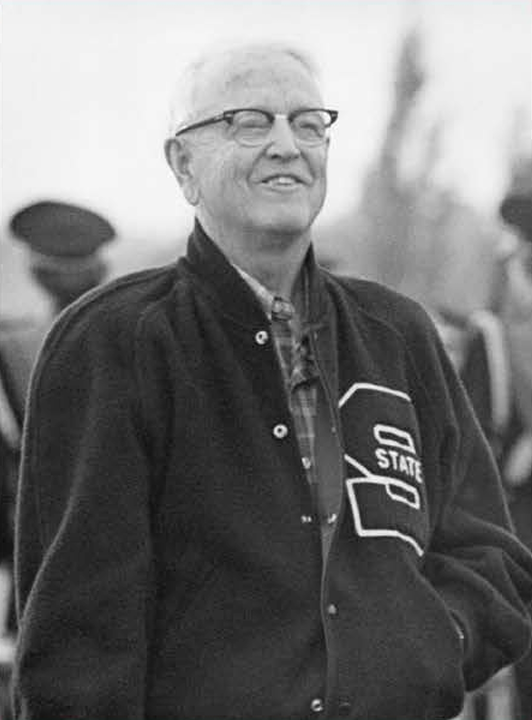
Sam DeMerit
In the first part of this series, I outlined their efforts to join the Little Ten Conference and how they ended in vain on three separate occasions. These failures were enough to get the athletic leaders of these schools to explore other options. As early as 1950, there were discussions of forming a new athletic conference for these schools. Cedarburg, Greendale, Menomonee Falls, Plymouth, and Port Washington were reported as members, and it was speculated that Little Ten members Hartford and West Bend would get invitations as well. Nothing came of this, but it started the ball rolling for future discussions.
This timetable was accelerated in spring of 1952, when three of the six schools in the 4-C Conference announced that the 1952-53 school year would be their last as members. Hartland, Pewaukee, and Slinger made plans to join the Southeastern Conference after three of their largest schools (East Troy, Mukwonago, and Wilmot) accepted an invitation to join the five Wisconsin-based schools that belonged to the recently disbanded SWANI Conference (Burlington, Delavan, Elkhorn, Lake Geneva, and Whitewater) in forming the Southern Lakes Conference for the 1953-54 school year. This development led to the dissolution of the 4-C Conference, with the three remaining schools (Cedarburg, Juneau, and Menomonee Falls) inviting Greendale, Oconomowoc, Plymouth, Port Washington, Sheboygan Falls, and West Bend to join them in the formation of a new conference to begin play the same year.
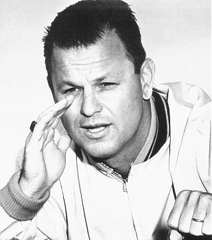
Vince Cibik
This proved to be more difficult than the two coaches anticipated. Port Washington turned out to be the only certainty among the invitees, having already been an integral part of discussions to start a new conference and failed Little Ten applicants along with Cedarburg and Menomonee Falls. Plymouth and Sheboygan Falls had no plans to leave their current home in the Eastern Wisconsin Conference, and Oconomowoc and West Bend were satisfied with their Little Ten affiliation and saw no need for change. The only other school invited (Greendale) chose to join the more established Suburban Conference when it came calling. To add insult to injury, Juneau backed out of these plans when they announced their planned entry into the Madison Suburban Conference to replace Middleton in 1953.
When this plan backfired, the three schools reached out to Watertown to begin discussions on the formation of a new conference as a contingency plan if they couldn’t get into the Little Ten. After their third and final application was turned down in December 1952, the four schools continued these talks, and a new conference was formed in October 1953. Named the Braveland Conference after another recent arrival in the Milwaukee area (the National League’s Braves), the organization began competition in time for the 1953-54 basketball season.
As new schools opened up in the Milwaukee area during the 1950s on what seemed like an annual basis, the timing of the Braveland’s formation turned out to be quite fortuitous. Still, the conference’s first reported new member was an established school that had been part of the 1950 discussions, Plymouth. Their anticipated entry date to the conference would have been 1954 had they not backed out and remained in the EWC. The recently opened Salem Central High School in western Kenosha County and St. John’s Military Academy, a private school based in Delafield, were also reported as invitees to the Braveland. Salem Central accepted their invitation to join the Braveland in 1955, while St. John’s declined and remained independent, as a private school being affiliated with a public school conference would have been a novelty at that time.
Salem Central’s entry into the Braveland was a bit curious, given their remote location in relation to the other four members of the conference. When the more centrally located Brookfield and Nicolet joined the Braveland in 1956, it gave them more away games to travel to, which became difficult for the small school. Their dissatisfaction with this arrangement led to their application to join the more geographically compatible Southeastern Conference, which was accepted and put into place for the 1958-59 school year. At the same time, the Braveland added two more recently opened schools: Granville (later Brown Deer) and Muskego, bringing the fledgling conference to a tally of eight member schools.
Watertown now became the Braveland’s main geographic outlier, and as relations with the Little Ten thawed after decades of bad blood, the prospect of them rejoining no longer seemed quite so far-fetched. In spring of 1958, after realignment talks between the Braveland, Little Ten, and Suburban Conferences broke off with no resolution, Watertown was invited to rejoin the Little Ten along with the newly opened Arrowhead High School in Hartland. Both schools accepted the invite and joined in 1959. Oak Creek High School, located on the south side of Milwaukee County, joined the Braveland as their replacement, keeping membership at eight schools.
Unfortunately, Vince Cibik didn’t get much time to see his co-creation come to life during these years, passing away in December 1954 after a battle with stomach cancer. But in the coming years, as the suburbs of Milwaukee experienced sustained growth and new school districts were formed, the Braveland Conference was left with a pivotal decision to make, which will be elaborated on in the third and final installment of this series.
