
Home of the Brave, Part 1

After World War II, urban areas across the country experienced a significant population increase, and in few places was this more evident than in Wisconsin’s largest metropolitan area. Growth to the north and west of Milwaukee brought previously remote outposts such as Cedarburg and Menomonee Falls closer and closer to the urban fringe. It was due in part to this growth pattern that their high schools looked to change their athletic affiliation in the postwar years. At that time, Cedarburg and Menomonee Falls were part of the 4-C Conference, short for Four-County and named after the four counties in southeastern Wisconsin where members were located (Dodge, Ozaukee, Washington and Waukesha). The other four schools in the six-team loop were Hartland, Juneau, Pewaukee, and Slinger. Cedarburg and Menomonee Falls were the two largest schools in the conference by enrollment and were the only ones aligned with Class B of the WIAA (the rest were in the smaller Class C).
Unfortunately, their options in the Milwaukee area were quite slim. The Milwaukee City Conference only contained schools affiliated with Milwaukee’s school district and had much higher enrollment levels than the two schools looking to exit the 4-C. Their other main option would have been the Suburban Conference, which at the time had nine members in Milwaukee’s streetcar suburbs. They had previously capped membership at eight schools when Whitefish Bay joined the conference in 1933 but ended up walking it back when West Allis added a second high school (Nathan Hale) at the end of the 1930s.
Having nine schools created problems with scheduling for the Suburban Conference, so they too began to explore options for a tenth member after World War II, setting their sights on Little Ten Conference members Oconomowoc. Cooney had little to no interest in leaving the Little Ten, a relatively stable conference that had been in operation since 1925 and contained schools of medium-sized enrollment northwest of the Milwaukee area. Two schools that had been competing as independents for many years, Port Washington and Watertown, were also considered for membership in the Suburban before they extended an invite to the first of the new post-war high schools to open in the Milwaukee area: Greendale High School, which opened in 1949 and joined the conference to coincide with its first senior class in 1952.
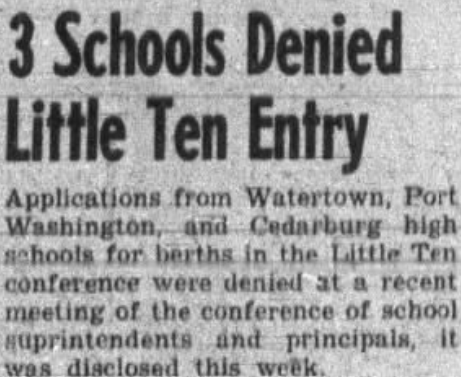
West Bend News, March 27, 1947
Recognizing their shared need for stronger competition, the four schools banded together and looked at the Little Ten as their ideal landing spot, with the first application submitted in 1947 by three of the four schools (Cedarburg, Port Washington, and Watertown). According to West Bend superintendent M.G. Batho, the conference didn’t want to expand their catchment area any further east or south, citing long travel distances for some members. Schools like Hartford, Oconomowoc, and West Bend would have had relatively little trouble adjusting, but schools like Berlin and Ripon would have experienced travel times up to an hour and a half each way to compete against the new members. It was because of this reason, along with the scheduling difficulties created by an odd number of schools, that their initial bid was rejected.
Undeterred, the three schools made another bid to join the Little Ten in 1950, and this time they were joined by Menomonee Falls. Their entry would have kept the Little Ten at an even number of schools but did nothing to rectify the travel issues of concern to some members. Additionally, per Waupun principal Erwin Pfefferkorn, the conference wasn’t willing to make a change due to the solid relations between the ten member schools. For longtime rivals Cedarburg and Port Washington, this rejection did come with a first chance at membership if things were to change, although it would be a very unlikely scenario. The newfound unity between rivals was a hint of things to come in later realignment, but that wouldn’t come until after a third attempt was made in 1952 by the four schools to join the conference. Just like the previous two attempts, the Little Ten said “thanks, but no thanks” to expansion.
Further complicating efforts was Watertown’s history with the Little Ten Conference. They were an original member of the conference when it made its debut in 1925 but quickly began to look at more competitive options for their athletic program. Within a month’s time in spring of 1928, Watertown accepted the conference’s basketball championship for the previous season at their annual meeting, agreed on football and basketball schedules for the next school year, and then abruptly withdrew from the conference. They joined with five larger schools to the south (Edgerton, Fort Atkinson, Monroe, Stoughton, and Wisconsin High) to form the Southern Six Conference, playing a partial football schedule with both conferences before entering the Southern Six on a full-time basis before basketball season started in winter.
Watertown’s exit on short notice didn’t do anything to endear them to their former rivals, nor did their dominance of the Southern Six for their new rivals. In just over a decade of membership, Watertown won six conference titles in football along with the 1930 state championship in basketball. They also grew at a faster rate than the other five schools, and this coupled with their athletic prowess led them to be voted out of the Southern Six by a 4-1 tally in 1941. Fort Atkinson, the closest rival to Watertown from a geographical standpoint, was the only member interested in keeping them in the conference. Watertown chose to leave their fate to the other five schools by abstaining from the vote. The five remaining schools joined with five schools who had recently left the South Central Conference (Baraboo, Portage, Reedsburg, Richland Center, and Wisconsin Dells) for similar reasons in forming the Southern Ten Conference in time for the 1941 basketball season.
In the second installment of this series, we’ll take a closer look at how two rival football coaches reshaped the future of high school athletics in southeastern Wisconsin.